 Dr. Alexander Stibor
Exploring Heterogeneous
Magnetic Quantum Materials
Dr. Alexander Stibor
Exploring Heterogeneous
Magnetic Quantum Materials
Current research activities
Studying heterogeneous magnetic quantum materials at their native time and length scale:
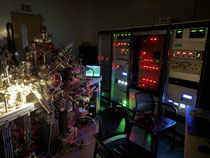
My current research centers on advancing our quantum spin‑polarized low‑energy electron microscope (QSPLEEM) as a unique platform for imaging and understanding heterogeneous magnetic quantum materials with nanometer spatial resolution and picosecond temporal precision. A major focus of my group is the experimental discovery and characterization of unconventional spin‑ordered phases such as altermagnetism, along with related phenomena in 2D magnetic materials such as CrSBr, spin textures, and quantum spintronic materials. By developing ultrafast spin‑polarized electron sources, cryogenic high‑stability imaging, and AI‑assisted measurement workflows, we aim to probe spin‑dependent band structures, ultrafast magnetic dynamics, and emergent symmetry‑driven effects that are inaccessible to conventional microscopies. At the Molecular Foundry, I support a broad user community working at the forefront of quantum materials, spintronics, and ultrafast magnetism, and position the QSPLEEM as a leading tool for revealing the microscopic mechanisms governing next‑generation magnetic quantum materials.
Development of novel coherent electron field emission sources:
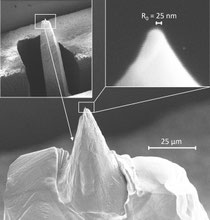
Electron beam emitters are applied in various fields of science and technology such as in electron microscopy, surface spectroscopy, matter-wave interferometry or sensor technology. Usually they
are realized by an etched metal tip set on a high voltage in vacuum. Our aim is to realize novel electron beam sources that apply the quantum nature of the emitter or the emitted electrons. This
can significantly increase the beam intensity and reduce the energy spread of the emitted electrons that in turn decreases the beam aberrations from electron optical components such es e.g.
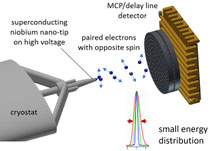
lenses in electron microscopes. Another goal is to realize beam sources that emit electrons in a highly coherent quantum state or even as entangled, correlated pairs such as theoretically
predicted from superconducting niobium nanotips. These kind of sources would have significant applications in electron spectroscopy and quantum information science.
Quantum decoherence by Coulomb-interaction:
Quantum applications rely on long coherence times, meaning that the system stays in a quantum state as long as possible. We study the transition from a quantum to a classical state (the so-called decoherence) induced by the Coulomb interaction. This is performed in an interferometer that prepares free electrons in
a quantum superposition state close to a normal-, semi- or superconducting surface. We could compare our measurements to different theoretical decoherence models. The studies have significant
applications in quantum information science, surface analysis, electron microscopy and the realization of hybrid quantum systems.